Ramayana Part 1: Beyond ROI
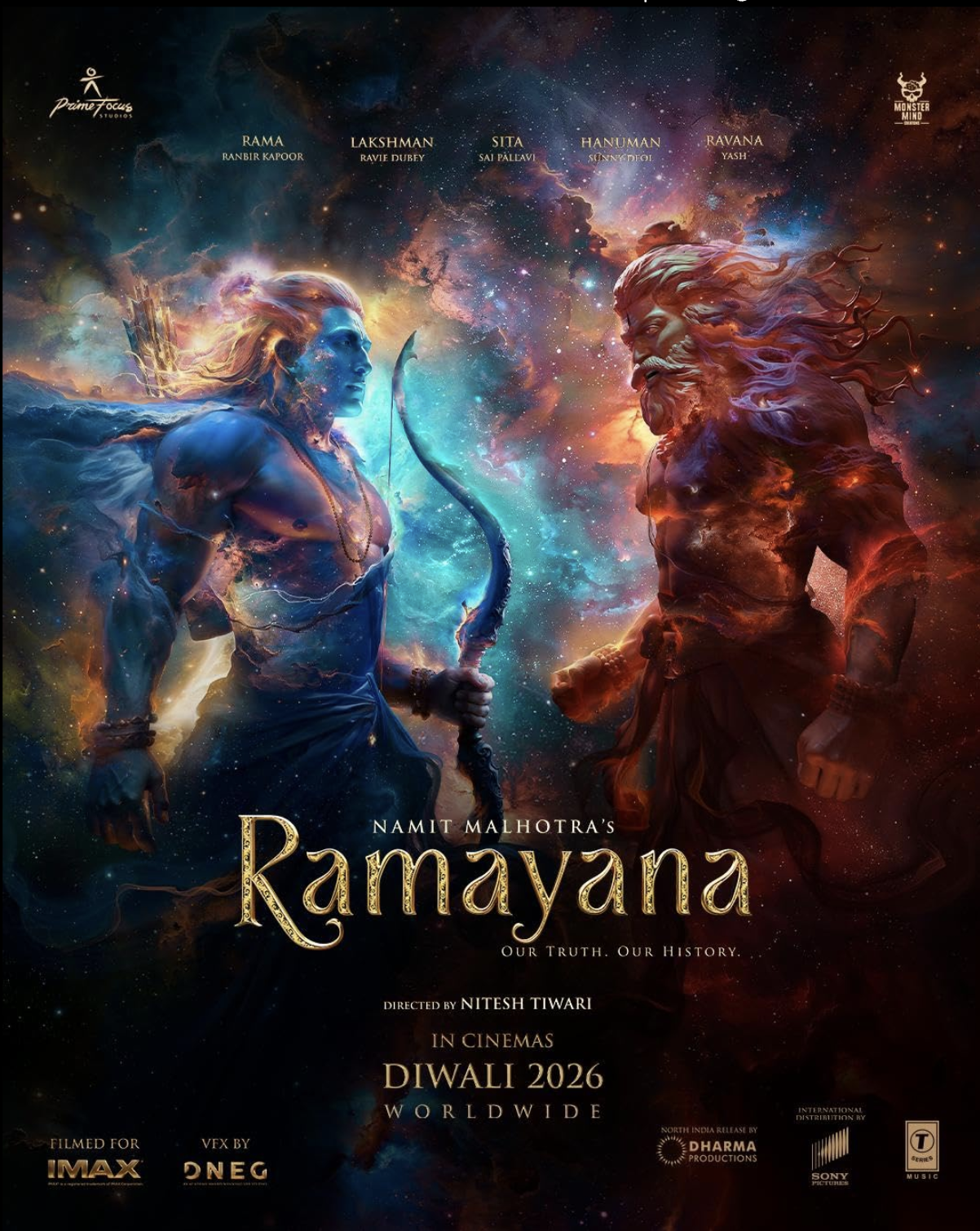
I walk into a mostly empty theatre in Ames, Iowa, on a weekend after Diwali, for the movie of Ramayana - one of the most recited sagas of all time, in Hindu mythology. Originally written by sage Valmiki in four parts, Ramayana has ample of versions, adaptations and folklore in every language of India. Ramayana is the story of the win of the good over the evil, the win of “dharma” over “adharma.” But to me, (and for many children like me growing up in traditional Hindu families till date), it is the story I grew up with. My childhood was full of Ramayana comics in kids’ digest and entertaining sub-plots being re-told at the dinner table. With a Chinese couple sitting right beside me and an Indian mother-son duo as my only company in the theatre, I felt a little tense - the stories I grew up with will now be presented on the big screen for the audience beyond Indians. I wondered if they would like the movie, whether they would appreciate the VFX (which was so hyped up in the media) and most importantly, would they connect with the story line emotionally, at all. After watching a 2 hour 46 minute long movie (without an intermission!) I think I got answers to a few of those. Keeping aside the movie budget, the religious take and movie’s possible political implications, here is me telling you the good and the bad aspects of the film - Ramayana: Rise of the Legend.
The story opens with the narration by Jatayu (the king of birds) explaining the basic premise of Hindu mythology, introducing Brahma, Vishnu and Mahesh - the three gods of creation, maintenance and destruction, and the war between Brahma’s two creations - Dev (representing the good) and Danav (representing the devil), which was won by Devas, creating a thirst for vengeance in Danavas. We then see the journey of a young Danav Dashaanan (the one who has ten heads), who gains a special boon of almost immortality from Brahma, and rises to become the devil king Ravana to accomplish the revenge. The rest of the movie is how Ram - the prince of Ayodhya, who always, (yes always!) chooses to walk on the path of “dharma”, always abides by the rules and believes in his destiny, finally makes a vow to ring down Ravana and kill him. This is a journey of a stoic prince and brave warrior Ram, to gain godly powers and kill different demons, when he was sentenced to live a life as a forest dweller with his wife Sita and brother Laxman. It is Ravana who abducts Sita, which makes Ram choose his destiny, instead of just believing in it.
The good: Retelling a story that all Indians have learned by heart is a sensitive task and the one that carries responsibility. There is no suspense in the story but only expectations from what you see on the screen. But the director Nitesh Tiwari and producer Namit Malhotra have made some wise creative and casting choices, that still make one interested in the movie. The idea of making Jatayu (voiced by Anupam Kher) the narrator is the key emotional anchor to the movie. Not only this, the entire cast has played the roles with sincerity. When one has to portray the devil, it is easy to get carried away in the extremities. Yash, who plays Ravana on the other hand, brings the arrogance, power and ego of Ravana in such a controlled manner. He shows the brutality of the character in killing Vidyutjeev(his brother-in-law), but never portrays Ravana as drunk on brutality. After all, he is a learned man who has the knowledge of the Vedas, a devotee of Shiva and Veena maestro. The Ravan-Tandav is choreographed so beautifully that one can see the devil king’s devotion to Shiva, but his evil and aggressive tendencies are also captured well in the body movements. Yash paints all shades of Ravana - ten shades, represented by ten alter ego personalities (which again is a fantastic creative choice instead of showing ten heads physically!) without glorifying the villain. Ravana, literally meaning the one who roars or the one who makes others weep, is personified in Yash’s every glance. Ram, played by Ranbir Kapoor, shows the restraint and the stoicism in the character. He always has a certain level of calmness in his body language . But Ranbir in my opinion has succeeded in not letting stability overshadow the range of emotions Ram feels. The story develops the character as someone who does not know himself as a reincarnation of Vishnu, but an ordinary human, choosing “dharma” - the duty, over and over again. We only appreciate the control in Ram, when we see him reaching his breaking point, when his wife Sita (played by Sai Pallavi) is abducted. Sai Pallavi fits so well in the role that I personally think that no one else could look so beautiful, natural and yet show the strength of the character at the same time. In the small screen time allowed to develop the chemistry between Ram and Sita, Sai’s presence around Ranbir, feels like relaxation and control amalgamated together. But if there is one role that I loved the most, it is that of Laxman played by Ravi Dubey. He brings the humor and impulsivity to the character with simplicity. It is Laxman who reminds Ram of the consequence of choosing the right path and there could be other ways to deal with situations. He aptly shows the audacity to question his elder brother’s choices while at the same time following him out of his love. The supporting cast of Shiba Chaddha as Mantra, and Shobana as Kaikasi, have made their impression even in the fleeting scenes.
The sheer VFX detailing of Lanka, the prosperity, the gold, the devil fauna is all commendable. I was convinced that the fauna in Ravana’s army (including the snow-lionish animal/pet Ravana has) could actually accompany them. The small detailing on ornaments and clothes on the kings, queens and princes of Ayodhya was noteworthy. The designers have made it intricate yet royal, without making it too much to occupy the vision. The entry scenes of every character are in line with their nature. This is where I personally felt that time and money invested in VFX and the score are worth the hype. A.R. Rahman and Hans Zimmer have created some fantastic score pieces for the scenes of Ravana’s tapasya, Ram’s entry sequence and when the trio of Ram-Sita-Laxman are leaving Ayodhya. Listening to the “dharti hai ambar hai” score while Ram battles with 14000 demons single-handedly gave me goosebumps. But the pinnacle of it all is the battle sequence of Ravana and Jatayu. I don’t think anything in Indian cinema has been delivered so perfectly and one can appreciate it only in the theaters! With all this being said, what could possibly be underwhelming?
The underwhelming aspects: Even though VFX are spectacular for the most part, some of the close-up scenes have sloppy backgrounds. Kumbhakaran and other important Danavas like Khar and Dushan are also completely CGI, and they just do not look appealing. For some sequences in Ayodhya and in Lanka, I suspected human figures were AI-generated. I also wondered about the reason behind the heavy use of CGI for generating the forest background, when the creators could have easily shot at the actual locations!
As I had suspected, the movie does not cover all the subplots. This leads to a lack of emotional connection with the characters. While Ravana’s journey has been shown in much more detail, in my personal opinion, Ram’s bonds with people around him do not get enough screen time. Ravana has the great stories of battles he won, but Ram’s real strength is his character, and his relationships. In front of Ravana’s multifaceted strong persona, Ram seems like a boring man. Yes, he indeed is boring, but by his ownchoice! The dialogues definitely convey this, but in a limited manner. Whether it be Ram calming down Laxman when he wants to kill their stepmother for sentencing them to the forest, him explaining to Bharat the importance of keeping vows as a king or him genuinely apologizing to Surpanakha for not marrying her because in his heart there is place for Sita alone, these are actually emotionally defining moments for Ram’s character arc. The movie runs so fast that I doubt whether the audience (especially international) can understand the emotional weight of these. Ram is a man who feels all the emotions but he can separate himself from those and make the choice that “dharma” tells him to, even in the hardest of situations. This is the reason he is called “maryadapurushottam” (the best among those who understand the boundaries). The movie quotes “dharma” plenty of times (and the word is kept as it is in the English subtitles), but conveys its meaning and importance in Ram’s heart to the audience. I wanted the scenes to last longer - I wanted a moment to see Ram and Sita’s relationship blossom, to breathe for a moment after a win of fighting Khar and Dushan’s uncountable rakshas army, a bit more time to look inside the overwhelmed state of Ram at the loss of his beloved wife! The songs from the album of the movie get hidden in the background as the story progresses. I have been playing “Mangal Rang” on loop and it’s an injustice to the song if it plays for even less than a minute in the actual film! The Ravan-Tandav song, which has some verses from “Shiv Tandav Strotram” by Ravana himself, receives similar treatment. The Sanskrit poem itself has great phonetical rhythm which the composers have either ignored or it gets sidelined amidst the orchestra.For the choreography that has the ability to consume the entire screen, a deeper and more aggressive song is required, which Ravan-Tandav fails to provide.
It could be the density and breadth of the original material or my familiarity with the story that makes me think that it could have been better, if it had been a trilogy instead of just two parts. Despite these constraints, I feel that the movie is good as a one-time watch (maybe it is not that unique of an experience from a CGI perspective as the creators claimed) and an entertaining “Intro to Ramayana: 101” short course. All I hope is that the second part of the movie, releasing on Diwali 2028, does justice to the Ramayana as Ram’s story, and ends on a good impactful note. After all, the story that ends well is remembered well!